What Retoswap is
RetoSwap is a private crypto exchange for peer-to-peer Monero swaps. It runs over the Tor network (a network that hides where a connection comes from). It has no accounts, no data collection and 0% trading fees. I designed its landing page and its desktop app interface, and I built the visual system behind both.
The problem
The promise of the product is privacy: no registration, no middlemen, no stored data. The platform never holds user funds, and every swap happens directly between people. The interface had to say the same thing, and stay usable for people who are careful about what they share.
My role
I did the product and brand design: screens, visual system and 3D assets. The project also included front-end development. I published it on Behance in July 2025.
What I designed
- The landing page. It gives access to the app and basic information, and nothing else: no forms, no accounts, no personal data. It opens on “Buy & Sell Monero” with one download button. Below it come 4 feature cards (non-custodial, no fees, peer to peer, powered by Monero and Tor), “Start swapping in 3 simple steps”, community comments, downloads for each platform and a FAQ.
- The desktop app interface. A dark screen with a price chart and a list of the currencies you can trade.
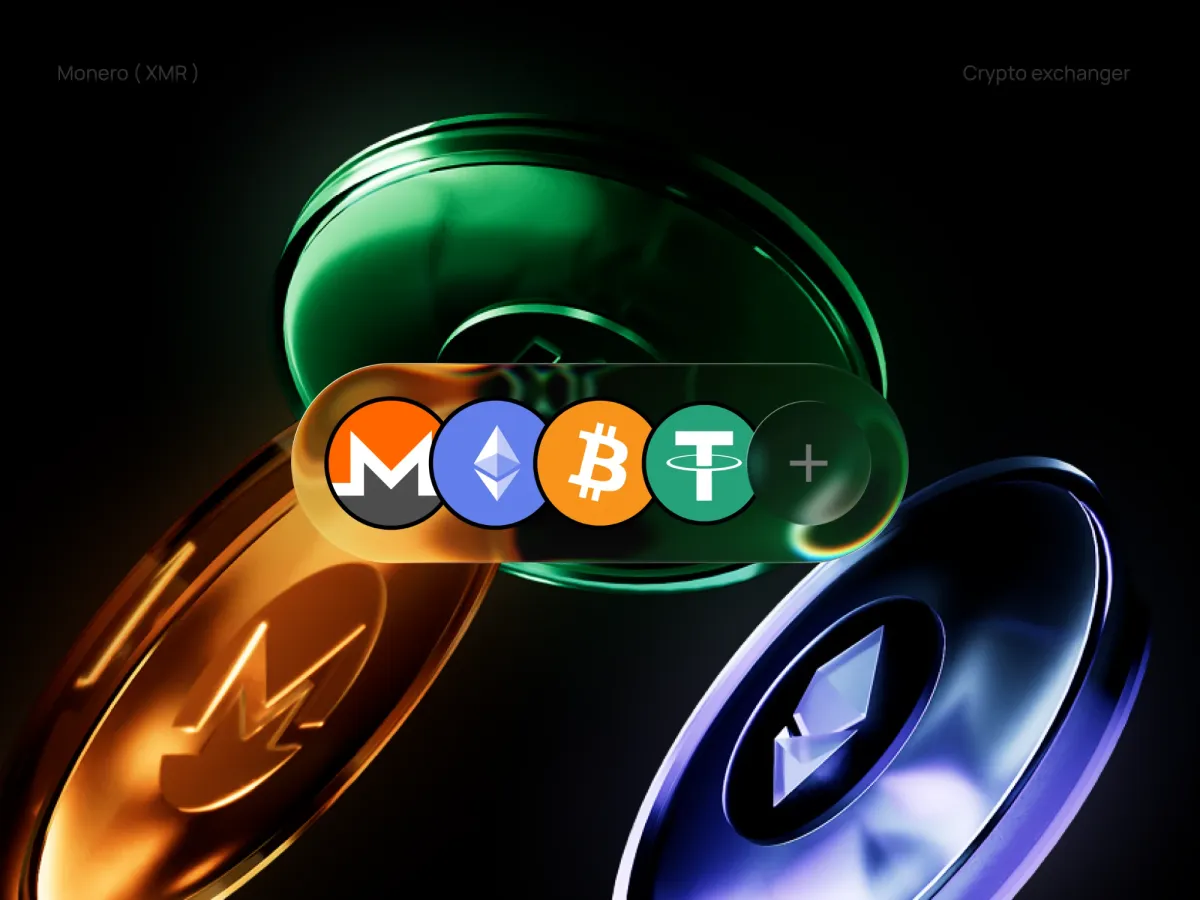
- The visual system. White headlines, light gray secondary text, a total dark background and a dark gray field for contrast. Each currency owns one color: orange for Monero, green for Tether, blue for Ethereum, golden yellow for Bitcoin and purple for Tor. The type is Manrope.
- 3D coin art. Glass and metal coins carry those colors through the page.
Design decisions
- Few things on screen. The interface stays minimal, so the actions take center stage.
- Dark and high-contrast. The palette echoes anonymity and makes every interaction easy to see.
- Color carries meaning. A color tells you which currency you are on, and spacing keeps the screen calm.
- A transparent texture. Glass-like surfaces echo the openness behind the system.
How the project ran
The project board lists 4 stages:
- First steps, 3 days: interviews and research.
- Discovery, 7 days: idea sketches, wireframes and user flows.
- “Doing some magic”, 2.5 weeks (the design stage): UX and UI, 3D assets, refining and the mobile adaptation.
- Development, 12 days: handoff, development and user testing.
Outcome
The result is a finished landing page and desktop app interface on one visual system. For another crypto product, see the Crypto Wallet case study.
The full project
Every screen is on Behance. Tools: Figma, Adobe Photoshop and Maxon Cinema 4D.
Working on something similar? Book a call
